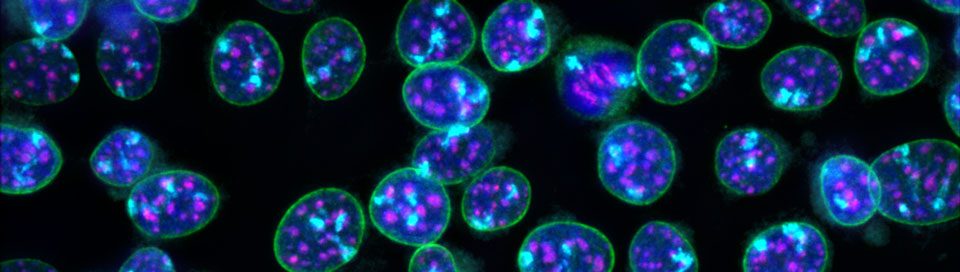
Inside the nucleus, DNA is not randomly arranged but folded into loops, domains, and territories that influence how genes are switched on and off. Our lab studies how this intricate 3D architecture is built and maintained, and why it matters for genome stability and health. We have shown that the protein complex cohesin helps create chromatin loops while also allowing flexibility at domain boundaries. This dynamic folding enables nearby genes to interact with the right regulatory elements, ensuring proper gene activity. Disrupting cohesin or its partners alters these interactions and changes gene expression patterns. We also discovered that another complex, condensin II, plays a very different but equally important role: it organizes chromosomes on a larger scale, shaping the size and separation of entire chromosome territories and reinforcing boundaries between active and inactive regions of the genome. By doing so, condensin II helps maintain the stability of the genome across cell types. Together, this work reveals that different folding machines act at different scales to shape the genome — cohesin driving dynamic, local communication between genes, and condensin II enforcing large-scale organization. In addition to these protein complexes, we investigate how chromosomes engage with nuclear compartments, such as nuclear speckles and the nuclear periphery, to regulate gene expression. Together, our studies are uncovering the mechanisms that fold the genome into a dynamic and functional three-dimensional structure.
 The Joyce Lab at UPENN